Crab Shell Pocket Bib Free Pattern: V-Stitch Crochet in Teal & Coral

Crab Shell Pocket Bib: Free V-Stitch Crochet Pattern in Teal & Coral
Introduction
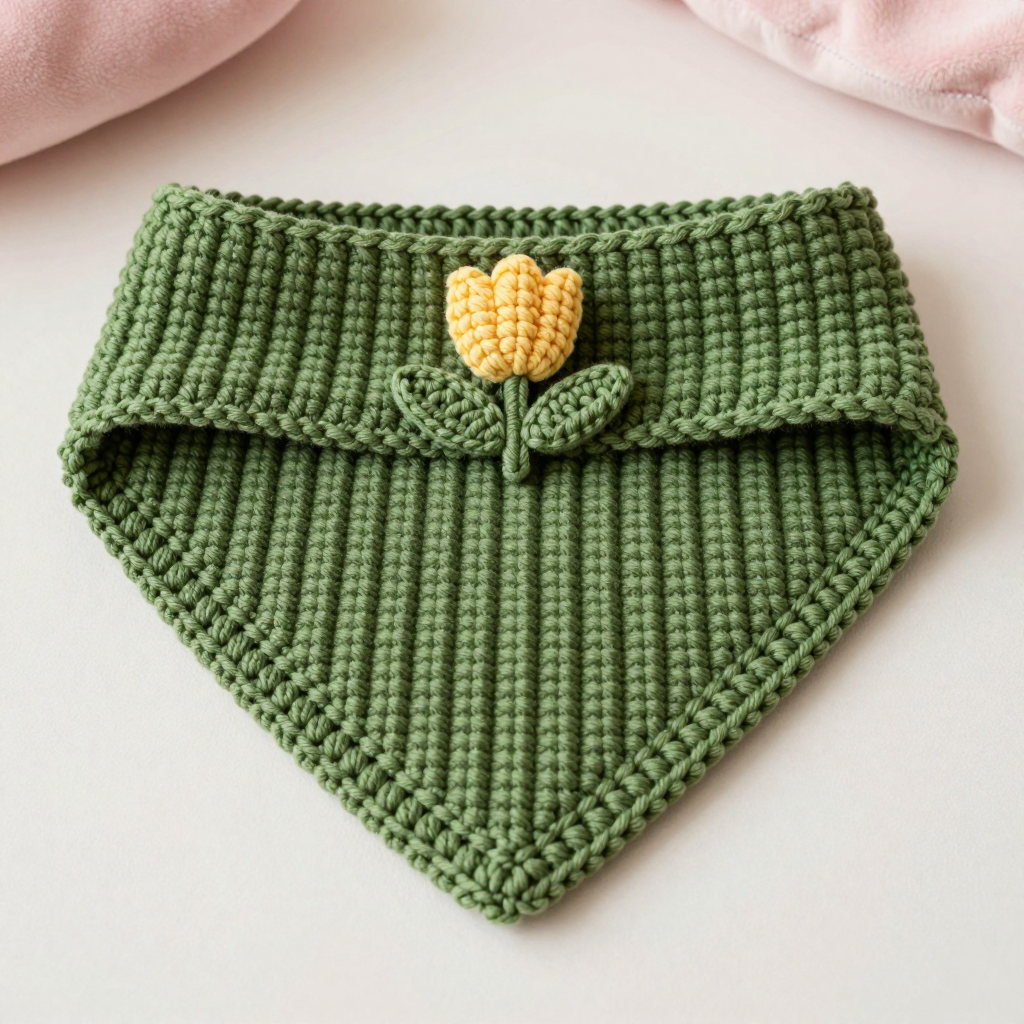
If you have ever admired a handmade baby gift and thought, "I could never do that," this is the project that will prove you wrong. The Crab Shell Pocket Bib is a flat, rectangular bib worked in soft coral bamboo cotton, with an airy v-stitch texture that looks fancy but is made from just one simple repeat. A teal half-circle "crab shell" pocket sits at the bottom to catch crumbs, and two tiny claw accents peek over its rim for a playful finish. The finished piece measures about 20 cm wide by 24 cm tall (8 x 9.5 in), feels silky and gentle against a baby's skin, and makes a truly special baby shower gift. It is designed for advanced beginners, which means if you can chain and make a double crochet, you can absolutely make this.
Materials Needed
- Yarn: Bamboo cotton, DK / light worsted weight (approx. 250 m per 100 g skein). You need 1 skein coral (approx. 45 g used) and 1 skein teal (approx. 15 g used).
- Main hook: 3.5 mm (US E/4) crochet hook — for the bib body and edging.
- Smaller hook: 3.0 mm (US D/3) crochet hook — for the pocket and claws.
- Stitch markers: at least 4 (to mark corners and the first stitch of rounds).
- Tapestry needle: a blunt-tipped needle with a large eye for sewing seams and weaving in ends.
- Scissors for cutting yarn.
- One button: approx. 1.5 cm (0.6 in) wide, for the neck closure.
- Small amount of fiberfill or yarn scraps to stuff the claws lightly.
- Blocking supplies: pins and a spray bottle of water (or a blocking mat).
Finished size: Bib 20 cm wide x 24 cm tall (8 x 9.5 in). Pocket 14 cm wide x 8 cm deep (5.5 x 3 in). Fits 6–12 months, with a neck loop adjustable via the button.
Abbreviations and Beginner Glossary
All terms are US crochet terms. Read this list once before you begin — every abbreviation in the pattern is explained here in plain English.
- ch — chain. Wrap the yarn over your hook and pull it through the loop on your hook. This makes a small "V" of yarn and is how every project starts.
- sc — single crochet. Insert your hook into the stitch, yarn over, pull up a loop (2 loops on hook), yarn over, pull through both loops. One loop remains.
- dc — double crochet. Yarn over first, insert hook into the stitch, yarn over, pull up a loop (3 loops on hook), yarn over, pull through 2 loops, yarn over, pull through the last 2 loops.
- sl st — slip stitch. Insert hook into the stitch, yarn over, pull the yarn through both the stitch and the loop on your hook in one motion. Used to join rounds or move without adding height.
- sc2tog — single crochet two together (a decrease). Insert hook into the first stitch, yarn over, pull up a loop; insert hook into the next stitch, yarn over, pull up a loop (3 loops on hook); yarn over, pull through all 3 loops. Two stitches become one.
- v-st — v-stitch. Work (dc, ch 1, dc) all in the same stitch or space. It looks like the letter V.
- ch-1 sp — chain-1 space. The little gap under the single chain made in the middle of a v-stitch. You work your next v-stitch into this gap.
- st(s) — stitch(es).
- rep — repeat. Do the instruction again.
- RS — right side. The "public" side of the fabric that faces out when worn.
- turn — flip your work over so you can crochet back along the row you just finished.
- magic ring — an adjustable loop of yarn you crochet into, then pull tight to close the center hole. If you prefer, chain 4 and join with a sl st into a ring instead.
- fasten off — cut the yarn a few inches from your work and pull the tail all the way through the last loop to lock it.
Gauge
Gauge: 4 v-stitch groups and 8 rows = 10 x 10 cm (4 x 4 in) in v-stitch pattern with the 3.5 mm (E/4) hook.
Why gauge matters: Gauge is how many stitches and rows fit into a set measurement. If your stitches are bigger than the pattern's, your bib will come out too large; if smaller, too small. Because this bib is a gift for a growing baby, getting close to gauge keeps the neck loop and body proportions right.
How to make a gauge swatch: With the 3.5 mm hook and coral yarn, ch 23. Work Row 1 as written below (you will get 7 v-st groups). Repeat Row 2 until you have 8 rows. Lay the swatch flat and measure a 10 cm (4 in) section across the middle: you should count about 4 v-stitch groups. Measure 10 cm (4 in) up: you should count about 8 rows. If you have more groups than 4, your stitches are too small — try a larger hook. If fewer, your stitches are too big — try a smaller hook.
Beginner Tips Before You Start
- Count your v-stitches every row. You should always have 13 v-stitch groups in the bib body. If you lose one, the edges will slant. Count before you turn.
- Use a stitch marker in the first stitch of each round on the pocket edging and claws, so you know exactly where to join.
- Do not pull your yarn too tight. Bamboo cotton has little stretch; tight tension makes stiff fabric and sore hands. Let the yarn flow.
- Work your v-stitches into the ch-1 space, not into the dc stitches. The gap is what creates the airy V texture.
- Keep your turning chain loose. The ch 3 at the start of each row counts as your first dc — if it is tight, the edge will pucker.
- Try the pocket on for size before sewing. Pin it in place first and check that the top edge sits about 4 cm (1.5 in) above the bib's bottom edge.
Step-by-Step Instructions
Part 1: Bib Body (coral, 3.5 mm hook, worked flat in rows)
Foundation: With the 3.5 mm (E/4) hook and coral, ch 39.
Row 1 (RS): Dc in the 4th ch from hook (this counts as your first dc plus a ch-1 space), ch 1, dc in the same ch — your first v-st is made. *Skip 2 ch, work (dc, ch 1, dc) in the next ch; rep from * to the last 2 ch, skip 1 ch, dc in the last ch. Turn. (13 v-st groups, plus 1 dc at each end)
Row 2: Ch 3 (counts as first dc), work (dc, ch 1, dc) in each ch-1 sp across, dc in the top of the turning ch. Turn. (13 v-st groups)
Rows 3–19: Repeat Row 2. (13 v-st groups; 19 rows total)
Do not fasten off yet. The piece now measures approx. 24 cm (9.5 in) tall and 20 cm (8 in) wide. Fasten off and weave in the ends.
Part 2: Neck Strap and Edging (coral, 3.5 mm hook)
With the RS facing you, join coral with a sl st at the top-right corner of the bib.
Round 1: Ch 1, sc evenly around the entire bib edge — work 1 sc in each row-end along the sides (about 3 sc per 2 rows) and 1 sc in each stitch along the top and bottom. At the top-right corner, ch 22 for the neck loop, then sl st back into the same corner sc to form a loop. Continue working sc around the remaining edges. At the top-left corner, ch 22, then sl st back into that corner sc. Join with a sl st to the first sc. Fasten off. (Neck loop approx. 30 cm / 12 in circumference when fastened with the button)
Sew the 1.5 cm (0.6 in) button to the front of the top-left corner, positioned so it meets the right neck loop.
Part 3: Crab Shell Pocket (teal, 3.0 mm hook, worked flat in rows)
With the 3.0 mm (D/3) hook and teal, ch 25.
Row 1: Sc in the 2nd ch from hook and in each ch across. Turn. (24 sc)
Row 2: Ch 1, sc in the first 2 sc, *2 sc in the next sc, sc in the next 2 sc; rep from * across to the last 2 sc, sc in the last 2 sc. Turn. (30 sc)
Row 3: Ch 1, sc in each sc across. Turn. (30 sc)
Row 4: Ch 1, sc in the first 3 sc, *2 sc in the next sc, sc in the next 3 sc; rep from * across to the last 3 sc, sc in the last 3 sc. Turn. (36 sc)
Row 5: Ch 1, sc in each sc across. Turn. (36 sc)
Row 6: Ch 1, sc in the first 4 sc, *2 sc in the next sc, sc in the next 4 sc; rep from * across to the last 4 sc, sc in the last 4 sc. Turn. (42 sc)
Row 7: Ch 1, sc in each sc across. Turn. (42 sc)
Row 8: Ch 1, sc in the first 5 sc, *2 sc in the next sc, sc in the next 5 sc; rep from * across to the last 5 sc, sc in the last 5 sc. Turn. (48 sc)
Row 9: Ch 1, sc in each sc across. Turn. (48 sc)
Row 10 (begin shaping the half-circle): Ch 1, sc2tog, sc in the next 18 sc, sc2tog, sc in the next 18 sc, sc2tog. Turn. (45 sc)
Row 11: Ch 1, sc2tog, sc in the next 16 sc, sc2tog, sc in the next 16 sc, sc2tog. Turn. (42 sc)
Row 12: Ch 1, sc2tog, sc in the next 14 sc, sc2tog, sc in the next 14 sc, sc2tog. Turn. (39 sc)
Row 13: Ch 1, sc2tog, sc in the next 12 sc, sc2tog, sc in the next 12 sc, sc2tog. Turn. (36 sc)
Row 14: Ch 1, sc2tog, sc in the next 10 sc, sc2tog, sc in the next 10 sc, sc2tog. Turn. (33 sc)
Row 15: Ch 1, sc2tog, sc in the next 8 sc, sc2tog, sc in the next 8 sc, sc2tog. Turn. (30 sc)
Row 16: Ch 1, sc2tog, sc in the next 6 sc, sc2tog, sc in the next 6 sc, sc2tog. Turn. (27 sc)
Row 17: Ch 1, sc2tog, sc in the next 4 sc, sc2tog, sc in the next 4 sc, sc2tog. Turn. (24 sc)
Row 18: Ch 1, sc2tog, sc in the next 2 sc, sc2tog, sc in the next 2 sc, sc2tog. Turn. (21 sc)
Row 19: Ch 1, sc2tog ten times. Turn. (11 sc)
Row 20: Ch 1, sc2tog across to the last sc, sc in the last sc. (6 sc)
Final edging round: Do not fasten off. Ch 1, sc evenly around the entire pocket edge — 1 sc in each row-end along the curved sides and 1 sc in each stitch along the top edge. Join with a sl st to the first sc. Fasten off, leaving a long tail for sewing.
Part 4: Claw Accents (make 2, teal, 3.0 mm hook, worked in the round)
With the 3.0 mm (D/3) hook and teal, make a magic ring.
Round 1: 6 sc in the ring. Join with a sl st. (6 sc)
Round 2: Ch 1, 2 sc in each sc around. Join with a sl st. (12 sc)
Round 3: Ch 1, *sc in the next sc, 2 sc in the next sc; rep from * around. Join with a sl st. (18 sc)
Round 4: Ch 1, sc in each sc around. Join with a sl st. (18 sc)
Round 5: Ch 1, *sc2tog, sc in the next sc; rep from * around. Join with a sl st. (12 sc)
Round 6: Ch 1, sc2tog around. Join with a sl st. (6 sc)
Stuff lightly with yarn scraps or a tiny amount of fiberfill. Close the opening by sewing through the remaining 6 stitches. Fasten off, leaving a long tail. Make a second claw the same way.
Assembly and Finishing
- Pin the pocket: Lay the coral bib flat with the RS up. Center the teal pocket on the lower half, aligning its flat top edge about 4 cm (1.5 in) above the bib's bottom edge. Pin along the sides and bottom curve only — leave the top edge open.
- Sew the pocket: Thread the long teal tail onto the tapestry needle. Working from the back of the bib so your stitches hide inside, sew small, even stitches along the sides and bottom curve of the pocket. Knot securely on the back and weave the tail into the fabric.
- Attach the claws: Sew one claw to each upper corner of the pocket rim, pointing slightly outward, using the long tails. Sew through the claw's base several times to anchor it firmly — babies pull!
- Weave in all ends: Thread each yarn tail onto the tapestry needle and pass it back and forth through the back of the fabric for about 5 cm (2 in), then trim close to the work.
- Block: Mist the bib lightly with water until damp but not soaking. Pin it flat to the finished measurements (20 x 24 cm / 8 x 9.5 in), smoothing the v-stitch rows straight and shaping the pocket's curve. Let it dry completely flat — bamboo cotton dries slowly, so allow several hours or overnight.
Pro Tips and Variations
- Change the colors: Swap coral for mint and teal for mustard, or work the bib in cream and the shell in dusty rose. Keep the pocket a contrasting color so the crab shell stands out.
- Adjust the size: For a smaller newborn bib, chain 33 instead of 39 (11 v-st groups) and work 16 rows instead of 19. For a toddler, chain 45 (15 v-st groups) and work 22 rows, then lengthen the neck loop to ch 26.
- Substitute yarn: Any DK / light worsted cotton or cotton blend works well. Avoid fuzzy or slippery yarns for the pocket, as they hide the shell shape. Always re-check your gauge with a new yarn.
- Make it a matching set: Work a second bib in reverse colors (teal body, coral shell) for a sweet pair, or add a small crocheted starfish to the pocket rim instead of claws.